Dismantling: the museum is closed until December 13rd. CID and Grand-Hornu remain accessible

Un équilibre temporaire
Un équilibre temporaire
Bringing together a dozen artists from a range of disciplines and backgrounds, the exhibition Un équilibre temporaire seeks to highlight contemporary art in the Wallonia-Brussels Federation through a selection of works that reflect artistic approaches that emerged around 2010. Even at this relatively short remove, the 2010s are already regarded as a watershed decade, when our transition into the twenty-first century truly took shape. Inevitably, this period also provided this generation of ‘millennials’ with a shared imaginary from which their own distinctive culture could emerge. Marked by geopolitical instability, environmental warnings and the accelerating pace of movement and exchange, this pivotal period saw terms such as ‘post-truth’, ‘polycrisis’ and ‘Anthropocene’ gain currency in the media – fashionable expressions symptomatic of a troubling sense of widespread upheaval. At this turning point in history, how can we not wonder whether our ability to preserve the world’s harmony is itself being eroded when, in an irony that borders on tragedy, it is our own actions that are now throwing that very world off balance? For artists seeking to bear witness to the existence of things through solid, autonomous and resilient works, the challenge, then, is to act as seismographs, registering the tremors of an ecosystem in a state of perpetual instability and so fragile that it stands on the brink of collapse. In much the same spirit, the exhibition presents paintings, sculptures, videos and performances that illustrate different ‘ways of working “in” and “with” this world as it comes undone’, to borrow the words of Jérôme André, who developed its concept alongside Grégory Thirion. - Director of MACS
Photo: Eva L’Hoest
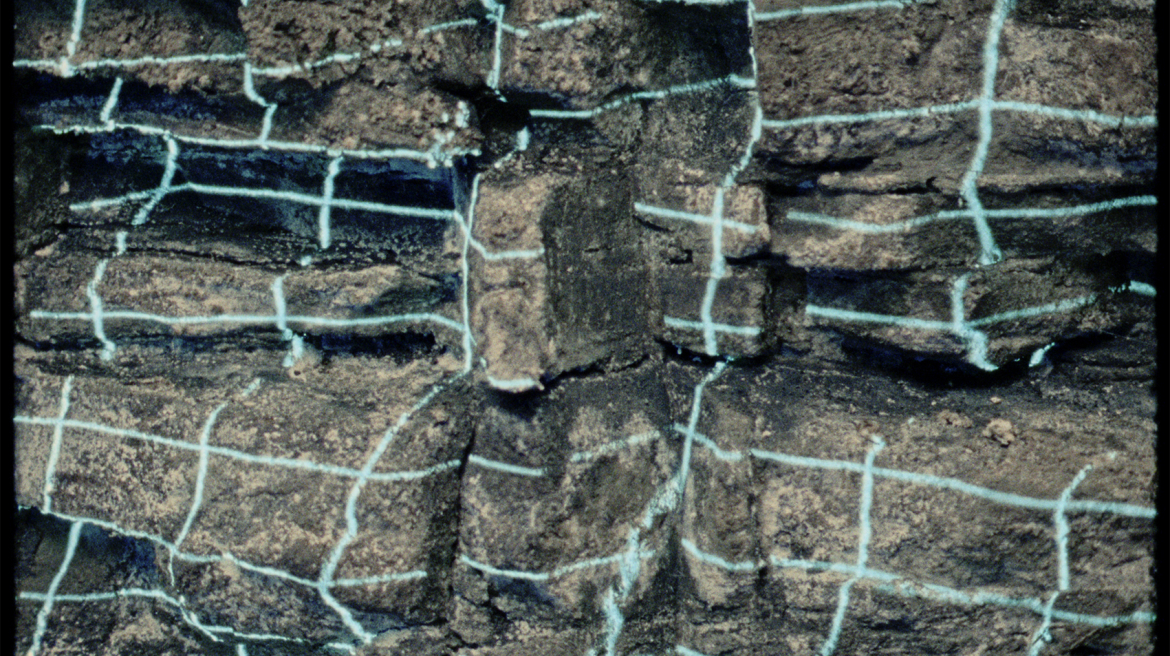
With works by Lara Gasparotto, Eva L’Hoest, Pierre Liebaert, Myrthe van der Mark, Xavier Mary, Julien Meert, Léonard Pongo, Yoel Pytowski, Stéphanie Roland, Maria Saygua André, Jonathan Sullam, Emmanuel Van der Auwera and Luca Vanello.
‘Humans are the planet’s real problem. The only solution is to destroy them.’ This quip comes from an AI teasing its creator after its cortex has ingested the entirety of big data. The machine mocks the prominence we give to narratives of our own extinction. Visions of collapse, apocalyptic consciousness and climate melancholy could be the defining concepts of a post-Anthropocene age: the Eschatocene – the age of the end times, an endless winter reminiscent of Cormac McCarthy’s The Road.
There is certainly no shortage of reasons to contemplate the end. Today, it is the leaders of the AI industry who are predicting humanity’s imminent demise, claiming that we will be superseded within five years. Yesterday, it was the continent engulfed in flames and gripped by drought that reminded us of the urgency of the climate crisis. Geopolitical, energy, public-health, banking and migration crisis are the pathological symptoms of a fragile world that could collapse at any moment, yet somehow manages to maintain a balance that is clearly on borrowed time – a temporary equilibrium.
This situation could be described as metastable: a theoretical point of equilibrium between two states, where the potential for change is not sufficiently great to cross what physicists call a bifurcation threshold. A minute fluctuation is all it takes to release this latent potential and tip a system into a different state. In computing, a flip-flop circuit (‘I’m either 0 or 1’) becomes metastable when the system momentarily loses synchronisation, leaving both possibilities open – a form of bipolarity. After a brief moment, it settles unpredictably into one state or the other, allowing the system to function – one viable outcome among several possibilities.
Should the world collapse and take us with it, it would, as Rosi Braidotti reminds us, mark only the sixth mass extinction. For this philosopher of posthumanism, this extinction will be driven by climate change, though it will not necessarily spell the end of all life. Rather than marking an irreversible tipping point, our Eschatocene presents the end times as a theoretical state. The prospect of a sudden, definitive end gives way to a state of metastability: extinction unfolding in stages, accompanied by a slow, deeply unsettling awareness of our own disappearance. This awareness finds expression in collapsology, the multidisciplinary study of the collapse of our thermo-industrial civilisation.
Should we, then, believe this machine that singles us out as ‘the planet’s real problem’, fed as it is on a steady diet of our own anxiety-ridden ‘posts’?
The exhibition Un équilibre temporaire neither compounds our doubts nor dispels them; nor do the works it brings together document or illustrate the state of the world, since they are, above all, forms of becoming – ways of working in and with this world as it comes undone.
The exhibition opens with Xavier Mary amid the ruins of our civilisation and concludes with Emmanuel Van der Auwera and Jonathan Sullam confronting us with a world that exists only as data – an ontology of the image. Luca Vanello’s works and Lara Gasparotto’s photographs invite us to reconsider the interstices of life, while Stéphanie Roland and Léonard Pongo propel us into the vast expanses of geological and cosmic time. In Eva L’Hoest’s work, a dissolved ‘self’ wanders through a space of introspection, while Maria Saygua André’s work reconnects us with matter and the memory of gesture. Yoel Pytowski’s installations and Julien Meert’s paintings confront the subject with solipsistic doubts about the reality of the surrounding world. It is this thinking subject, suspended in time, that Pierre Liebaert captures in his portraits, while Myrthe van der Mark’s educational notebooks evoke Rudolf Steiner’s anthroposophy and the subject’s permeability to a supersensible world.
- Jérôme André, curator
This exhibition has been organised in partnership with Le Botanique