Interview with Honoré δ’O

The title of your exhibition, “Quarantine-Quarantaine”, suggests both isolation and a kind of spiritual retreat. You spent forty days in the Chihuahua desert, I guess it was a powerful experience, both physically and mentally. What does it mean in your work? Do you need to be at a distance from the world in order to create?
Indeed, I like to take a step back, to gain an overall perspective. It’s my nature, which is more reflective than actively participating. I try to feel what is happening around me, between myself and the environment. Then I listen to the echo within myself. In a way, I enjoy solitude; it is an agreeable state. During this sort of “quarantine” — without obligations and without of the usual daily tasks — I feel lighter, less wrapped up by the dynamics of social and economic traffic. In Marfa, being constantly absorbed by a wonderful environment, I felt unified with the whole existence, not at all separated or limited. I strongly noticed a kind of reversal, I do not absorb the environment, the environment absorbs me. Consequently, the situation delivered a fresh definition of inspiration. The world shows itself continuously as a living logic, as the clear explanation of our quests. The composition reveals the answers, it’s visual language that can be read. We only need a motivated state of mind. The method can be used day and night, without muscle effort or working.
How precisely did that time in the desert shape or inspire the exhibition?
When I arrived in Texas, I had planned to visit nearby towns and villages, and to see a few art centers and famous collections. But when I reached the desert and stood — for the first time — on the terrace of my trailer, the landscape struck me, I got paralyzed for a moment — the horizon line from east to west, and just in front of me, in the middle of the scope, the magnificent mountain Haystack. My agenda evaporated, instinctively I decided to stay in the given setting and called the mountain my ‘companion’. These sensations would accompany all my experiences throughout the period of my stay.
I was not expected to create anything during the residency, I could stay without the obligation to produce, to present or to represent, the exhibition at MACS hadn’t yet been planned. That comfort and freedom made everything even easier, no work to do, just δ’O to do. Video became a very natural tool to play with in those circumstances. I recorded lots of short performances, instantly inspired by ideas that arose while observing the light, the wind, breakfast and vegetation, dust devils during the day, milky ways at night, ...
It’s also striking how the vastness of space goes hand in hand with the vastness of time. I had an ocean of time to reflect on my earlier work, on my chaotic archive, on the common thread that is becoming increasingly visible in the whole of my activities; I will certainly bring back fragments from the past and integrate them into the Chihuahua story of the residency in Grand Hornu.
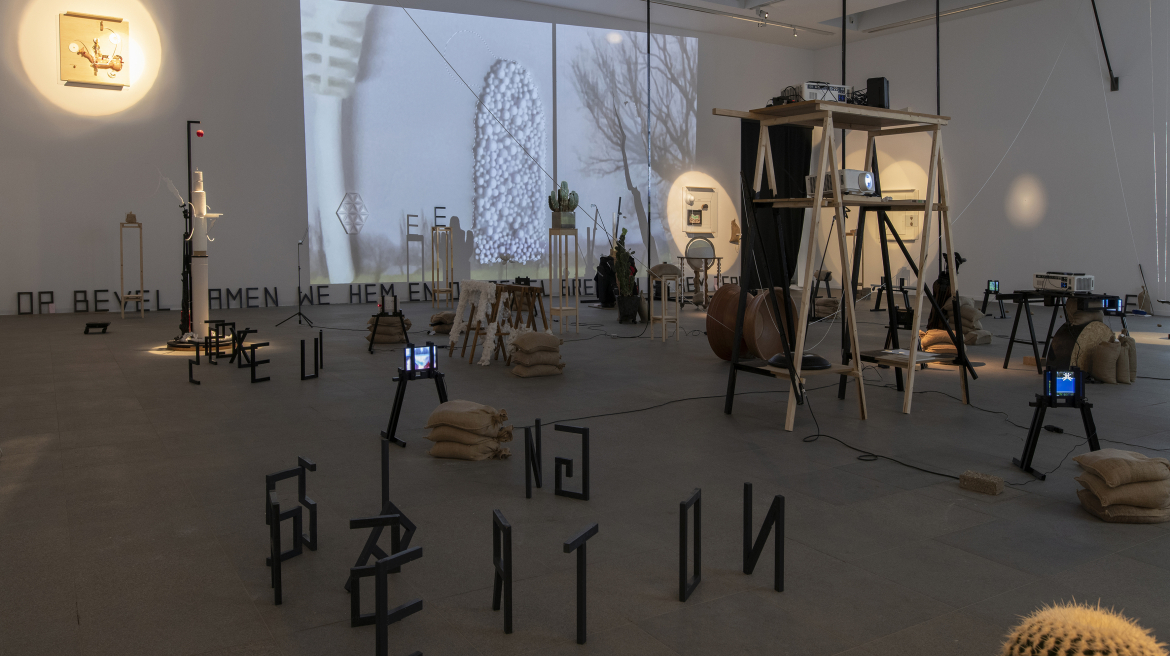
The exhibition unfolds in the large square room at the MACS. How did you work with this architecture to evoke the feeling of the desert or to stage your works within it?
First of all, I don’t need the condition of white walls, but they gradually can become the frame through which I tell my story — they may become an integral part of the installation. If you were to propose a location like the door handle, the bottom of the table, the roof of the building, the border of the village, whatever, I could gratefully accept. As a painter I quickly stepped away from the canvas. Nowadays I’m painting in the air, air is the canvas or the pedestal on which I place my images. Air is substantial in my compositions. Before starting the installation process, I never have a precise idea of what the exhibition will look like. I have fragments, lots of basic materials, notes and tones, but before they become a melody, the processing remains open. The small poem could turn into a symphony, or just becoming invisible and transformed into a smell. The present stuff and matter must cancel itself out and above all show the image of relationship and connection.
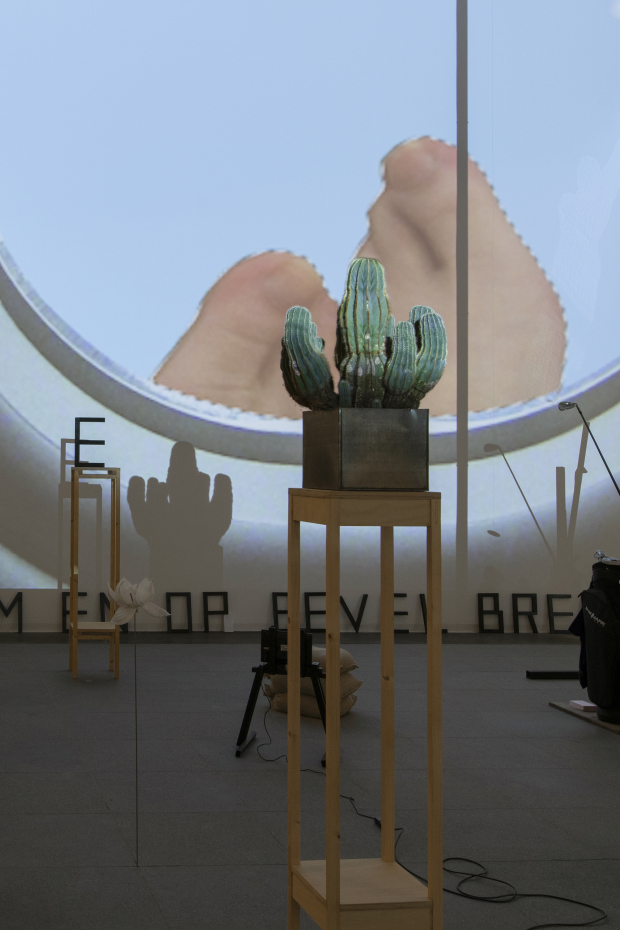
Of course, the square room is very suitable for displaying the videos. I’m interested in the light, projected light is filled with content, but still immaterial, it fits with the atmosphere in Marfa. I’m searching for a mental response, far from a purely material of object-based image, but maybe I’ll bring cacti to Hornu, or golf clubs. Amazingly, a small village in the desert has a golf course. Water resources exist in the subsurface beneath the Marfa Plateau. The water flows from the mountains towards the Rio Grande, the border with Mexico.
The square room is also a closed box, the perfect architecture for a quarantine. it separates a spatial part from the spatial whole, the separation prevents a possible wrong confrontation between different points of view, it protects both what is outside and what is inside.
Your work is about creating relations between materials, objects, and ideas. What do you hope visitors will feel or take away after experiencing this “quarantine”?
I consider this installation as a sort of replica of the Chihuahua Desert. Like people are tasting the dishes in the restaurant, they can interpret the cooking. In the source you find the pure ingredients. Visitors are part of the happening, part of the art. Perhaps the installation will also resemble a cactus, the viewer might prick himself. I like the element ‘danger’, it feeds 8
the awareness. Even before the trip I imagined the risky plan to walk as far as possible into the desert, with the courageous and fairytale-like certitude that I could succeed in arriving back home. The concept of danger and surviving is part of the adventure.
I hope that people can carry the exhibition and take it home with them. But obviously you can only truly understand a work of art if you give it genuine attention. Like a book — if you want to know what’s inside, you must read it, follow the relationships between the words and the sentences, the paragraphs and the chapters. The energy floats in the air that the visitor breathes. If the public becomes part of the art, it can begin to reflect. The ideal situation is an installation that feels like an embrace. A hug in a labyrinth, you get lost but you’re guided, you’re guided out by the way things are arranged. Such an event is a modest but real and delicate QUARANTAINE emotion.