Interview with Cristina Garrido
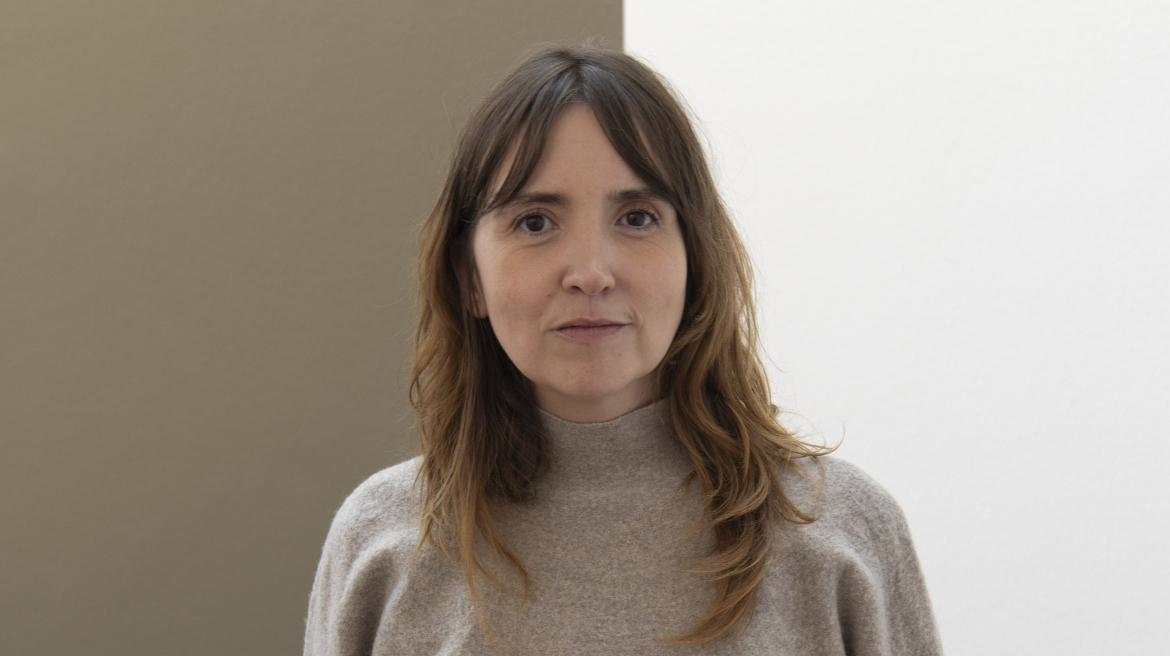
How would you describe your art in a few sentences?
In my art practice, I often use art –the professional field and context in which I perform and where my works circulate – as a way to ask questions about broader social, political, and cultural issues. I see it as a a form of research that questions the function and meaning of artistic practice and art history through the development of certain methodologies, that result in images, objects or actions.
What was your first encounter with art history?
Although my father was not professionally involved in culture, he has always been passionate about painting and used to take me to museums from a very young age. The names of well-known painters were somehow present in my upbringing and became familiar to me early on.
When I studied Fine Arts at the Complutense University of Madrid —a school still rooted in traditional disciplines and strongly focused on technical skills— my interest in art history grew alongside my practice. I became fascinated by how art history doesn’t simply describe works. It is allegedly an objective practice, but constructs narratives that shape the way we perceive art. These stories often become so powerful that they end up replacing the experience of the artworks themselves.
I’m interested in how these frameworks of interpretation are built — who gets to tell them, and how they influence what we value or overlook. Not only art historians, but also art photographers, curators, and institutions participate in this storytelling, defining the visual and discursive conditions through which we encounter art.
Grand-Hornu is a former coal mining site with unique architecture and light. How did the museum influence the way you conceived your exhibition?
Visiting the museum several times while preparing the show was very helpful. I saw different exhibitions taking place and noticed how much the atmosphere could change, despite the building’s strong character.
More than its distinctive architecture, my interest and inspiration have been drawn to the museum as a container of multiple experiences and memories — the exhibitions that have taken place within its walls since its foundation in 2002, the audiences who have visited, the artists who have shown their work there, the museum’s staff and the art photographers whose images allowed me to dwell on those past exhibitions I didn’t see in person.
During one of my visits to Brussels, I became interested in meeting the Belgian art photographer and artist Philippe De Gobert, a true legend of the Belgian art scene, who has documented exhibitions at MACS for many years — as well as across the country — and who also had a solo show there in 2017. Visiting him in his studio alongside Denis Gielen and Jérôme André and seeing his photographic archive was really special. His work documenting exhibitions — along with that of the amazing art photographer Isabelle Arthuis, who has more recently continued this task — has both conceptually and materially influenced the new work I produced for the show: Déjà-vu – Salle Pont, MACS, Grand-Hornu (2002–2025).
This installation reflects on everything that has existed there before my exhibition. It is an almost invisible gesture, one that evokes the memory of past artworks and artists who have inhabited that space. Since one of the museum’s missions is to engage with memory, I see this piece as a kind of response to that idea of remembering or looking back.
This new installation uses anamorphosis. How did you begin working with this technique, and how has it evolved for this exhibition?
It began with a previous project, a video and a book titled The Invisible Art of Documenting Art — a research project on the figure of the art photographer, an almost invisible yet essential presence in the art system. Today, we experience art mostly through digital media — computers, websites, social platforms — seeing far more “images” than artworks themselves.
While conducting this research, I realized that this task is often carried out by a very small number of people. It’s striking to think that most exhibitions in a country like Belgium or Spain are often seen through the lens of the same few photographers. That made me wonder: who are these people? Do they like art? What are their preferred ways of documenting it? How do they decide how to photograph an exhibition or an artwork?
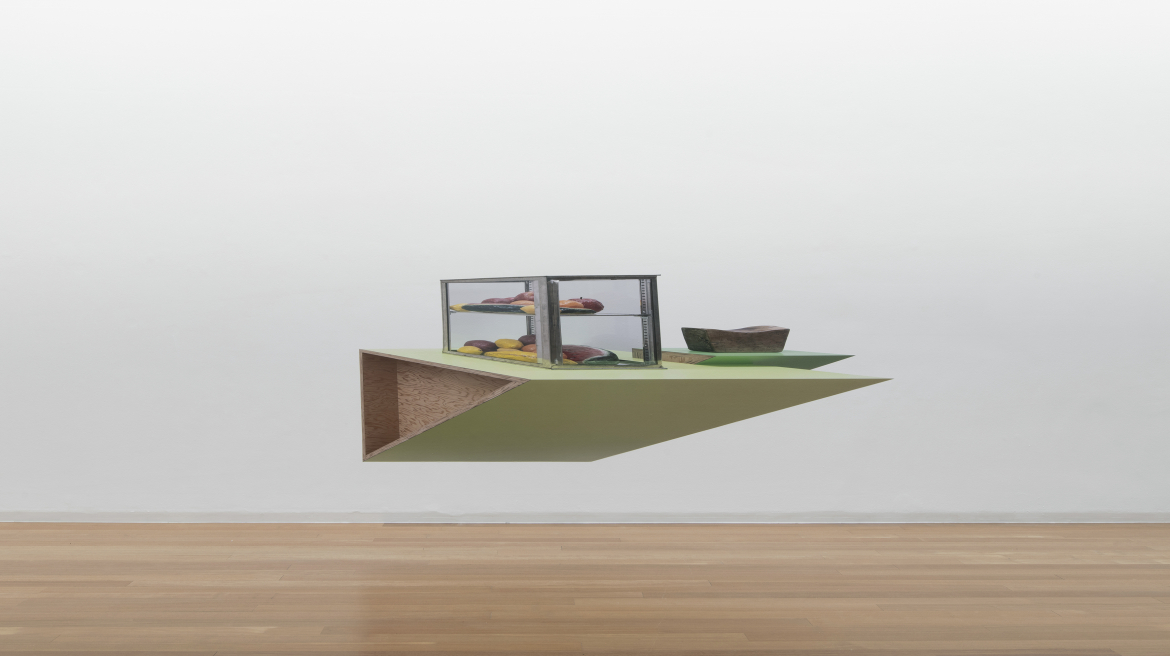
From there, I became interested in anamorphosis — a technique that makes the viewer’s point of view visible. When we look at a photograph of a sculpture, we tend to assume the photographer is objective, that they don’t manipulate what we see. But what if reality is entirely different from the image? In a way, every photograph is an anamorphosis…
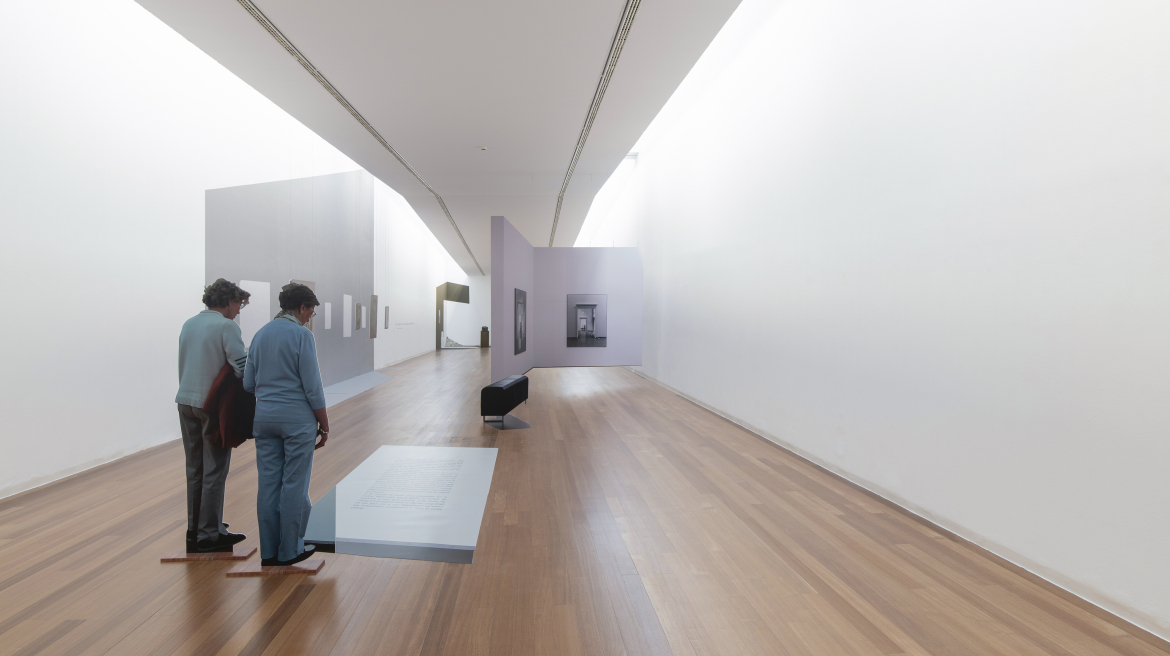
For this new installation, together with my assistant Alberto Custodia, we developed a software process to insert and distort photographers’ images, revealing the original viewpoint from which they were taken. I started exploring this idea in my recent exhibition at Bombon Projects in Barcelona, where I re-created five images of previous exhibitions — placing each one exactly where the original artwork had been. It was a kind of spatial or sculptural documentation.
For Déjà Vu – Salle Pont, MACS, Grand-Hornu (2002–2025), I wanted to move beyond the photographic frame and make the viewer’s interaction more playful and even humorous. Because the room is so long, we built structures behind which visitors can hide or reappear, so not everything is visible at once. Some images aren’t anamorphoses but borrow from the visual language of fairs or advertising — ephemeral structures that appear, seem real, and then vanish again. The whole installation functions like a stage set, almost theatrical.
Why did you choose the title "The White Cube is Never Empty" for the exhibition?
I was thinking about how museums or art spaces in general are haunted by ghosts — by the lingering presence of previous exhibitions and stories. When you begin working in a space, it’s never a blank page; it’s full of traces and voices that came before you — like art history itself.
The title reflects that idea: I rely on those earlier presences and begin a dialogue with them. At the same time, taken more literally, it also points to the constant production and circulation of art, which sometimes leaves us little time to pause, reflect, or fully absorb it.
You’ll also be showing a work based on curators’ Instagram posts. You’re reimagining it here. Is adapting your work to new contexts something you often do?
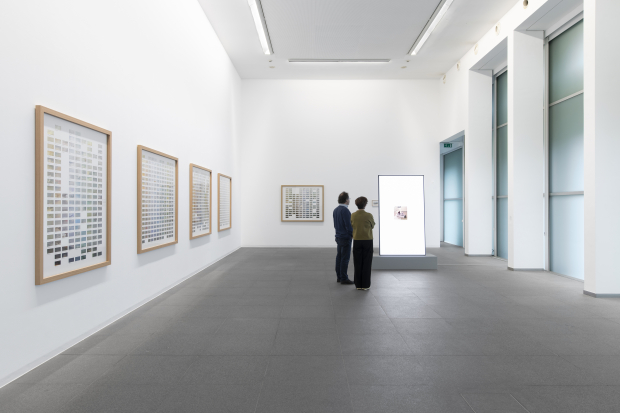
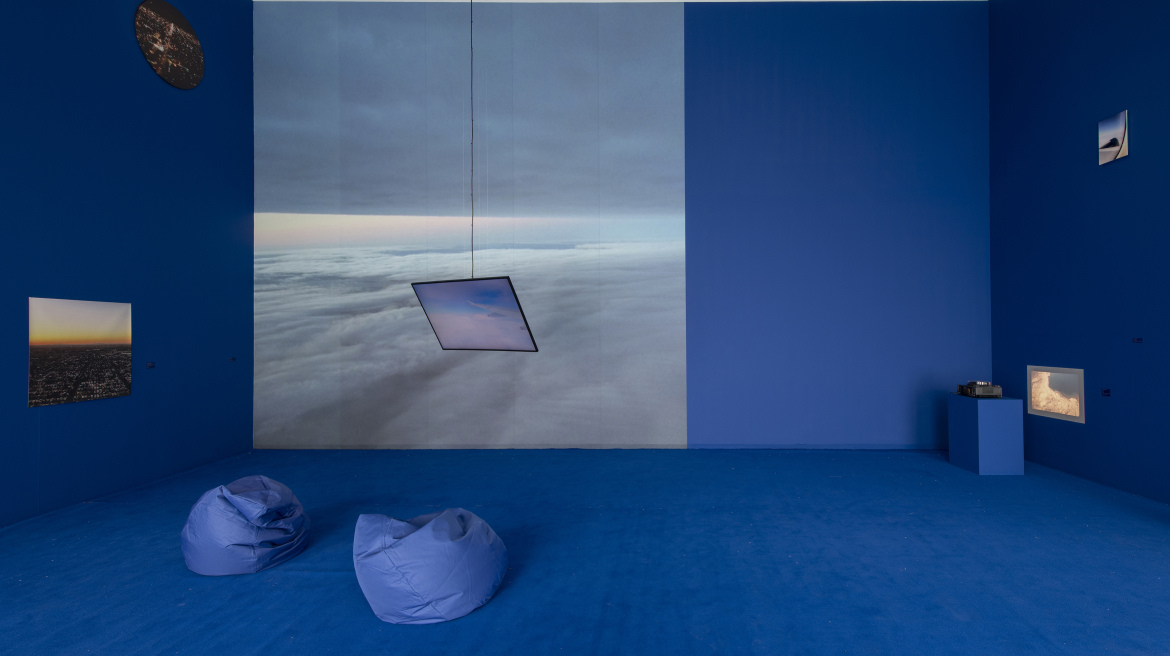
Many of my works begin as collections of images. At first, I don’t always know what they will become. I often ask myself: the collection is interesting — but does it need to become something else? In 2016, I began gathering images from curators’ Instagram accounts and conceived it as an exhibition of curators within an exhibition.
In the end, these are just Instagram images printed in different media; for them to appear as real artworks, the exhibition space needs to support them. In a way, the show itself becomes the work, and I act as its curator. I built and presented this installation before, but I was never fully satisfied with the effectiveness of the exhibition device. For Grand-Hornu, the challenge was to imagine how this piece could exist as an exhibition within the exhibition. I chose to perform this through architectural and decorative elements, such as the overall deep blue color, using a visual language reminiscent of contemporary group shows. The deep blue tones make the images seem to float, evoking sensations of air travel or airports.
I like the idea that artworks can adapt and update certain elements to remain effective in the present.
Your work engages with AI, Instagram, and other technologies. How important is it for you to use current tools that evolve so quickly?
I’ve always been curious about new tools, but I am not a fan of cutting-edge technology for its own sake. However, I try to make work that responds to the present, so I consider using the tools that are available at the time I create a work.
In my recent video piece, Paragraphs on Make-Up Art (2025), for example, what mattered about using AI software was its capacity to create the illusion that a group of makeup artists were reciting Sol LeWitt’s Paragraphs on Conceptual Art.
You’ve also invited a Belgian copyist to paint views of the exhibition live, once a month. What inspired that?
I wanted to incorporate this performance within the show, because it relates to my Spanish background but also connects with the history of painting in Belgium — two cultures where painting holds a central place in Western art history. The central idea of this piece is to highlight or insert a human presence that would use his observational and painterly skills to give a visual testimony of the show. A person who will spend more time looking at the exhibition through his hands. It dialogues with the idea of the witness of art (alongside the art photographer or the anonymous viewer), as different timing to look at an artwork, as well as the singularity of the point of view.
It’s a somehow anachronistic technique, but one I deeply respect. What happens when someone trained to copy Rubens turns their gaze toward an installation or video work installed within a contemporary art museum? It’s quite poetic — and yes, it even smells of turpentine in the museum! Watching a painter at work is also a process that we all really enjoy watching, even if you don’t like contemporary art. I was really lucky that my friend Christophe Veys found Daniel Cooreman, who regularly copies a work by Quinten Massys in the Royal Museums of Fine Arts of Belgium in Brussels, and he was willing to perform.
What matters most to you about how the public experiences your exhibition?
I hope the works and the exhibition are accessible to a diverse museum audience. I consider the viewers constantly when making work — physically, conceptually, and even politically — and I aim to create works that communicate beyond the art world by offering multiple layers of access (for example, titles are very important in my practice). I’m not interested in being cryptic. I understand art as a tool for communication, and I see my pieces as platforms for discourse or as devices that can provoke ideas and encourage viewers to question certain issues in an open and reflective way.